

- This event has passed.
Commemorating Jacques Viau-Renaud: Dominican Sovereignty, and Antonio Lockward-Artiles and Pedro Caros’ Island-wide Afro-Caribbean Geopoetics
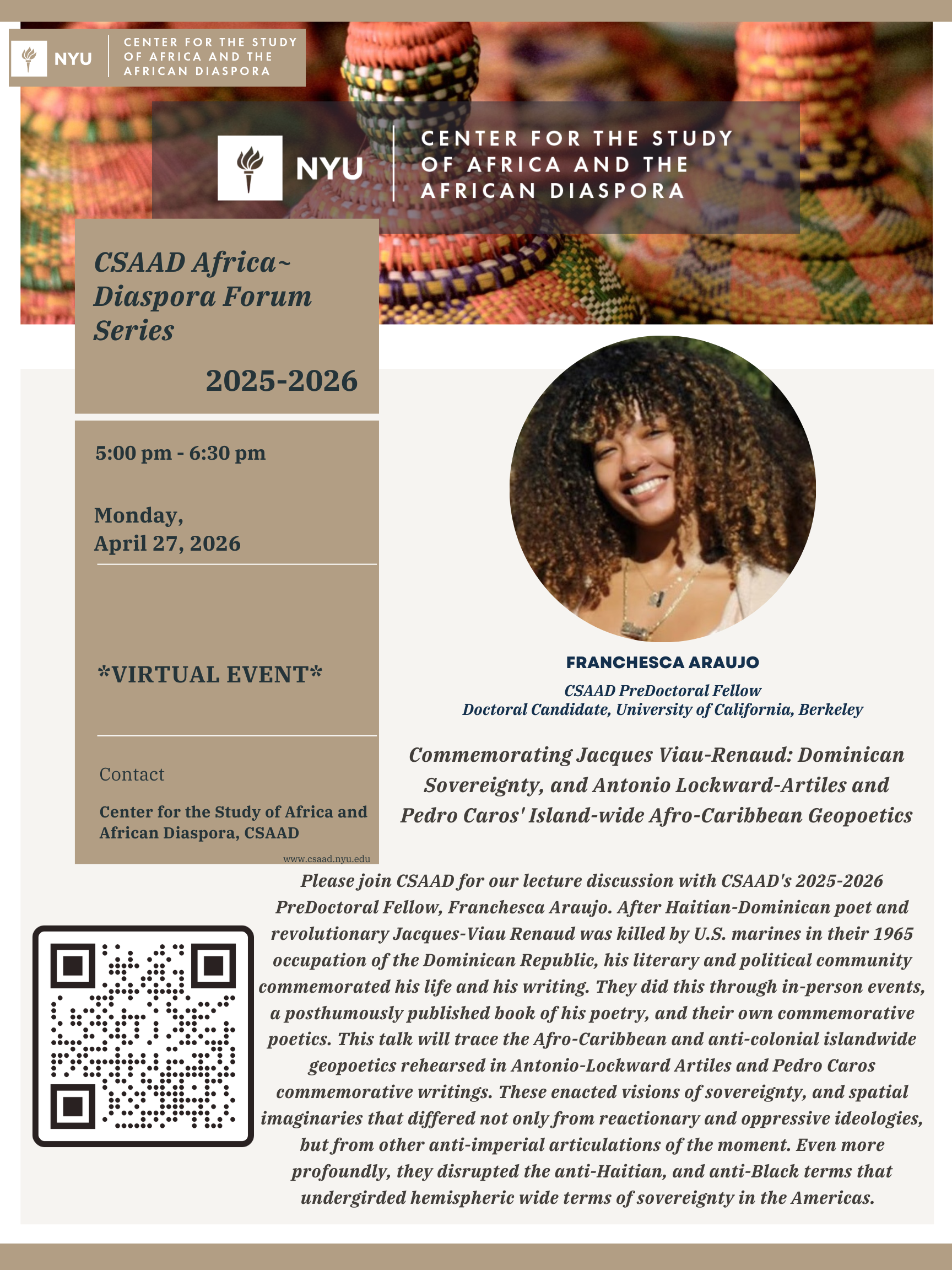
CSAAD Africa~Diaspora Forum Series
CSAAD PreDoctoral Fellow Presentation
Franchesca Araujo
CSAAD 2025-2026 PreDoctoral Fellow
University of California, Berkeley
Monday, April 27, 2026
5:00 pm – 6:30 pm
*VIRTUAL EVENT*
Zoom link: https://nyu.zoom.us/j/95259797641
Please join CSAAD for our lecture discussion with CSAAD’s 2025-2026 PreDoctoral Fellow, Franchesca Araújo. After Haitian-Dominican poet and revolutionary Jacques-Viau Renaud was killed by U.S. marines in their 1965 occupation of the Dominican Republic, his literary and political community commemorated his life and his writing. They did this through in-person events, a posthumously published book of his poetry, and their own commemorative poetics. This talk will trace the Afro-Caribbean and anti-colonial islandwide geopoetics rehearsed in Antonio-Lockward Artiles and Pedro Caros commemorative writings. These enacted visions of sovereignty, and spatial imaginaries that differed not only from reactionary and oppressive ideologies, but from other anti-imperial articulations of the moment. Even more profoundly, they disrupted the anti-Haitian, and anti-Black terms that undergirded hemispheric wide terms of sovereignty in the Americas.
For accommodations, please contact the Assistant Director for the Center for the Study of Africa and the African Diaspora at ac8829@nyu.edu.
Watch Recording Here
Bio:
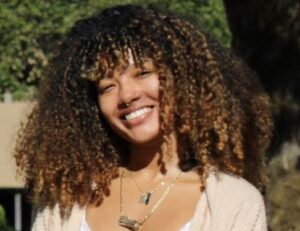
Franchesca Araújo is a doctoral candidate in African Diaspora studies at the University of California, Berkeley. She is an interdisciplinary Black Studies, Caribbeanist scholar. Her work interrogates the linkages and fissures between colonial modernity, nation-making, culture, and national subjecthood across a variety of media and histories. Her dissertation looks at how 20th and 21st century Dominican subjects, media, and events encounter the Dominican Republic’s classed, racialized, and spatialized value systems across different political and cultural moments. Using archival research, close reading, and visual, discursive, and reflexive analysis, she theorizes the analytics of deficiency, and excess at the intersection of black geographies and black disability studies. She argues this opens up more capacious ways to think about encounters between blackness, the nation, and the national subject. Franchesca’s research interests broadly include theorizing black geographies, Hispanophone Caribbean popular culture, music, performance, and aesthetics, 20th century anti-colonial Caribbean thought, and coloniality and anti-blackness within Latin American nation-making and Latinidad as an imagined community. Her poetry can be found in When Language Broke Open (University of Arizona Press), and her scholarship in The Berkeley Review of Latin American Studies as well as The Afro-Latin@* Reader: Vol 2 (Duke University Press).